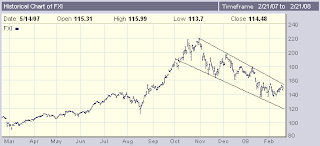
The iShares FTSE/Xinhua China 25 Index ETF (FXI) has been in a downtrend for months. In the last month or so it has bounced off a support level in the $140 area several times. The ETF has finally begun to turn up. On Tuesday it came right up against its downward sloping trend line. On Wednesday it fell back within the channel (see chart below).
Are we seeing merely technical trading or are there fundamental developments in the Chinese economy that will drive the ETF one way or the other?
In reviewing some of the recent news out of China there are a couple of developments that are worth discussing.
Inflation
China's consumer price index was reported up 7.1% in January, the highest since September 1996 and well above December's 6.5%. This was partially due to the severe winter storms that disrupted economic activity, caused crop damage and generally brought parts of the country to a standstill. Some analysts that this high level will not last and that China will see a moderation in prices.
On the other hand, Chinese authorities have placed price caps on certain categories of food (food prices climbed 18.2%) and it is well known that the government subsidizes oil imports in order to keep prices at the pump artificially low. Without these government induced distortions, would the CPI have been even higher?
With prices rising, it increases the likelihood that China will allow its currency to appreciate more rapidly. This is something the U.S. has been asking China to do but the Chinese government has been moving slowly in order to avoid making Chinese goods less competitive abroad.
Interest Rate Outlook
With inflation this high and bank accounts yielding only about 4%, there are expectations that the central banks will be raising rates. In the current state of affairs, depositors are getting a negative rate of return compared to inflation. With the standard weapon for fighting inflation being an increase in interest rates, we will almost certainly see a tightening in China this year.
To help cool the economy, the Chinese government supposedly set limits on lending. It appears that Chinese banks have ignored the limits. Lending continues at strong levels and plenty of liquidity is available for real estate and industrial borrowers.
Economic Activity
Last week it was reported that China's trade surplus in January exceeded analyst expectations. There have been many anecdotal stories of how Chinese exporters are already suffering as a result of the U.S. slowdown. These numbers, however, paint a different picture. In December, we saw the surplus come down a bit but now it seems to be right back at the strong levels China has become used to seeing. And this is despite the high prices of oil which inflate the import numbers.
We have pointed out in the past that China is developing a strong domestic market and is seeing growing trade among Asian neighbors and other emerging nations. It appears that, so far at least, China is protected by some degree of decoupling.
Conclusion
The Chinese economy continues to roar along. If things don't get any worse in the U.S.; ie, we don't fall into a deep recession, it looks like China can escape without a major slowdown.
As always with China, the government is the wild card. If they allow the yuan to appreciate, if they raise rates aggressively, it could throw Chinese stocks into turmoil. After the extremely strong gains of last year, a case can still be made that Chinese stocks are overvalued and vulnerable.
As for FXI, it has been trapped in this chart pattern since last October. We'll need to keep a close watch as this can't continue forever.

Are we seeing merely technical trading or are there fundamental developments in the Chinese economy that will drive the ETF one way or the other?
In reviewing some of the recent news out of China there are a couple of developments that are worth discussing.
Inflation
China's consumer price index was reported up 7.1% in January, the highest since September 1996 and well above December's 6.5%. This was partially due to the severe winter storms that disrupted economic activity, caused crop damage and generally brought parts of the country to a standstill. Some analysts that this high level will not last and that China will see a moderation in prices.
On the other hand, Chinese authorities have placed price caps on certain categories of food (food prices climbed 18.2%) and it is well known that the government subsidizes oil imports in order to keep prices at the pump artificially low. Without these government induced distortions, would the CPI have been even higher?
With prices rising, it increases the likelihood that China will allow its currency to appreciate more rapidly. This is something the U.S. has been asking China to do but the Chinese government has been moving slowly in order to avoid making Chinese goods less competitive abroad.
Interest Rate Outlook
With inflation this high and bank accounts yielding only about 4%, there are expectations that the central banks will be raising rates. In the current state of affairs, depositors are getting a negative rate of return compared to inflation. With the standard weapon for fighting inflation being an increase in interest rates, we will almost certainly see a tightening in China this year.
To help cool the economy, the Chinese government supposedly set limits on lending. It appears that Chinese banks have ignored the limits. Lending continues at strong levels and plenty of liquidity is available for real estate and industrial borrowers.
Economic Activity
Last week it was reported that China's trade surplus in January exceeded analyst expectations. There have been many anecdotal stories of how Chinese exporters are already suffering as a result of the U.S. slowdown. These numbers, however, paint a different picture. In December, we saw the surplus come down a bit but now it seems to be right back at the strong levels China has become used to seeing. And this is despite the high prices of oil which inflate the import numbers.
We have pointed out in the past that China is developing a strong domestic market and is seeing growing trade among Asian neighbors and other emerging nations. It appears that, so far at least, China is protected by some degree of decoupling.
Conclusion
The Chinese economy continues to roar along. If things don't get any worse in the U.S.; ie, we don't fall into a deep recession, it looks like China can escape without a major slowdown.
As always with China, the government is the wild card. If they allow the yuan to appreciate, if they raise rates aggressively, it could throw Chinese stocks into turmoil. After the extremely strong gains of last year, a case can still be made that Chinese stocks are overvalued and vulnerable.
As for FXI, it has been trapped in this chart pattern since last October. We'll need to keep a close watch as this can't continue forever.
Comments
What is 'Recession Proof'?
You can almost hear the wallets snapping shut. Folks are cutting back on their spending every way they can. According to those who know, we are either in a recession, or are about to be.
I would hate to be trying to sell
real estate or new cars right now. Talk about hitting your head against the wall. Ouch!
That got me to thinking of what businesses make sense during a recession. Certainly health care does. Baby boomers are going to need every kind of health care imaginable. For all I know, economic bad times makes
people sick too.
Other types of businesses that should be recession proof include vital home repairs, like plumbing, electrical, and roofing. Folks can't put off fixing a clogged toilet or a leaking roof just because they're a little short on cash.
And you know what they say about death and t.ax.es. A well-run funeral home or a tax consulting business shouldn't be hurt by an economic downturn. But all these jobs require training, and even certification. And that takes time. By the time you've learned one of these trades, the recession may well be over. That got me to thinking about one business that's truly recession-proof, and you can get started almost immediately: Day Trading.
Day Trading refers to the buying and selling of stocks within the same trading day. I know what you're thinking: how can a day trader be successful when the stock market is down, day after day? Well, day traders profit from
volatility - when there are big swings in stock prices, there is money to be made.
It used to be that Day Trading was only done by financial institutions with access to technology and information. Now, almost anyone with Internet access can become a day trader, if they know what to do.
Manny Backus
P.S. Learn a 'sleazy' trading technique used by a select group of traders to bank lucrative, net stock returns of $223.00, $476.10, $790.25 or more -- not in days or weeks -- but in one easy hour or less! Click here:
http://www.firsthourtrading.com/
Post a Comment