Consumer discretionary stocks have been in the news lately. As oil prices moderated and the U.S. dollar appreciated, the stocks shot upward. The consumer discretionary ETFs, naturally, followed suit.
There are a number of fund companies that offer ETFs focused on the consumer discretionary sector. They include:
Focus on the ProShares ETFs --
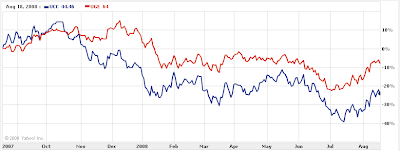
Since the stock market peak in the fall of 2007 UGE has performed better than UCC. You can see UGE in red in the chart below and UCC in blue. What might account for that difference?
The Consumer Services ETF (UCC) includes all kinds of retailers as well as cable companies, media companies, restaurants, airlines, advertising companies, hotels and casinos. As we know, airlines have been hammered by high fuel prices. Retailers have suffered as the real estate crisis has depressed consumer sentiment and gas prices lightened consumer wallets. High gas prices have also encouraged consumers to drive less. Less traveling has, of course, negatively impacted the hotels and casinos. All in all, this ETF has a great deal of vulnerability to a slowing economy and the process of inflation eating away at disposable income.
The Consumer Goods ETF (UGE) includes the companies that actually produce the products sold at the retailers that are part of the holdings of UCC. Thus, there is a certain linkage between the two ETFs. Dragging down the performance of UGE lately are U.S. auto makers and a selection of homebuilders. The problems in these two sectors are serious and well known. There are also a number of companies that might also be found in a Consumer Staples ETF and it appears that these stocks have been helping to prop up the ETF.
So both ETFs include stocks that are in sectors that are under extreme pressure. The difference between the two seems to be related to exports. The Consumer Goods companies that actually manufacture products have the potential to sell those products worldwide. With many of the services companies, they derive the majority of their revenue from customers in the U.S.
Conversely, with the U.S. leading the global economy downward, it makes sense that Consumer Services would be the worse performer.
Conclusion --
ProShares allows investors to more finely tune their approach to the Consumer Discretionary sector. When inflation is falling, the economy strengthening, real wages increasing and consumer sentiment improving the Consumer Services ETF (UCC) would probably outperform. In an economy as we see it today with dismal consumer sentiment, rising prices reducing consumer spending power and better growth taking place in developing countries, the Consumer Goods ETF (UGE) will at least do better than Consumer Services.
Both ETFs rallied lately but seem to have failed to get through their downward trending 200-day moving averages. With the U.S. economy in a questionable state and foreign economies showing signs of slowing, it is conceivable this recent rally is at an end. I suspect investors would do better at this point by buying either of the two ultra short ETFs.
Disclosure: none
There are a number of fund companies that offer ETFs focused on the consumer discretionary sector. They include:
- Consumer Discretionary Select Sector SPDR (XLY) - large-cap blend with 83 stock holdings
- PowerShares Dynamic Consumer Discretionary (PEZ) - mid-cap blend with 60 stock holdings
- Vanguard Consumer Discretionary VIPERS (VCR) - large-cap blend with 411 stock holdings
- Ultra Consumer Goods (UGE) - large-cap blend, 147 holdings
- Ultra Consumer Services (UCC) - large-cap blend, 226 holdings
- UltraShort Consumer Goods (SZK) - large-cap blend, 147 holdings
- UltraShort Consumer Services (SCC) - large-cap blend, 226 holdings
Focus on the ProShares ETFs --
Since the stock market peak in the fall of 2007 UGE has performed better than UCC. You can see UGE in red in the chart below and UCC in blue. What might account for that difference?

The Consumer Services ETF (UCC) includes all kinds of retailers as well as cable companies, media companies, restaurants, airlines, advertising companies, hotels and casinos. As we know, airlines have been hammered by high fuel prices. Retailers have suffered as the real estate crisis has depressed consumer sentiment and gas prices lightened consumer wallets. High gas prices have also encouraged consumers to drive less. Less traveling has, of course, negatively impacted the hotels and casinos. All in all, this ETF has a great deal of vulnerability to a slowing economy and the process of inflation eating away at disposable income.
The Consumer Goods ETF (UGE) includes the companies that actually produce the products sold at the retailers that are part of the holdings of UCC. Thus, there is a certain linkage between the two ETFs. Dragging down the performance of UGE lately are U.S. auto makers and a selection of homebuilders. The problems in these two sectors are serious and well known. There are also a number of companies that might also be found in a Consumer Staples ETF and it appears that these stocks have been helping to prop up the ETF.
So both ETFs include stocks that are in sectors that are under extreme pressure. The difference between the two seems to be related to exports. The Consumer Goods companies that actually manufacture products have the potential to sell those products worldwide. With many of the services companies, they derive the majority of their revenue from customers in the U.S.
Conversely, with the U.S. leading the global economy downward, it makes sense that Consumer Services would be the worse performer.
Conclusion --
ProShares allows investors to more finely tune their approach to the Consumer Discretionary sector. When inflation is falling, the economy strengthening, real wages increasing and consumer sentiment improving the Consumer Services ETF (UCC) would probably outperform. In an economy as we see it today with dismal consumer sentiment, rising prices reducing consumer spending power and better growth taking place in developing countries, the Consumer Goods ETF (UGE) will at least do better than Consumer Services.
Both ETFs rallied lately but seem to have failed to get through their downward trending 200-day moving averages. With the U.S. economy in a questionable state and foreign economies showing signs of slowing, it is conceivable this recent rally is at an end. I suspect investors would do better at this point by buying either of the two ultra short ETFs.
Disclosure: none
Comments
Post a Comment